This review is fairly safe to read if you haven't read the book (i.e., it doesn't give away any major plot points or twists in the story).
 Although the title of this post gives the publishing date 1967, The Third Policeman was actually written sometime between 1939 and 1940. It was O'Brien's second novel, and after it was rejected by publishers he claimed to have lost the manuscript. It was made available to the public after his death.
The fact that The Third Policeman was written some two decades before the 1960s only makes it seem all the more groundbreaking for its time. It's nonetheless an accessible book, considering. The main story follows the narrator — an unnamed murderer — into an absurd world full of strange characters and odd devices. So far, so Alice in Wonderland.
As he finds himself getting increasingly lost, however, he takes comfort in the equally eccentric ideas of a philosopher named de Selby, with whom he's apparently obsessed. These ideas emerge primarily via footnotes that appear throughout the book. One in particular spans eight pages and outlines in some detail a bitter but amusing rivalry between scholars of de Selby. Long, comic footnotes and endnotes are the much remarked upon trademarks of the more recently deceased David Foster Wallace, yet here was O'Brien using a similar technique back in the Ireland of the 1940s.
Whereas Wallace stated that he used footnotes and endnotes to embody the slippery nature of consciousness and better represent the fractured nature of modern reality [1], O'Brien's technique here seems more a balancing act of absurdities and unrealities. The footnotes actually make the book easier to read. And it's a credit to O'Brien that he's able to relegate the more obvious satire to the small print — de Selby as mad scientist seems familiar if only because it's a well-worn caricature, and the childish quarrelling of academics who should know better adds a gentle but real humour to an otherwise bewildering book.
Not that the 'actual' world of The Third Policeman is totally without logic or plot. Its main preoccupation seems to lie with science and technology — "The Machine Age" — and its effects on reason and, ultimately, people. At one point a character known as the Sargeant breaks it down for the narrator, literally:
We have a machine down there [...] that splits up any smell into its sub- and inter-smells the way you can split up a beam of light with a glass instrument[...], you would not believe the dirty smells that are inside the perfume of a lovely lily-of-the-mountain. [p143]This passage might remind some of Patrick Suskind's Perfume (which I'll perhaps review another time) though the pursuit there is aesthetic — not apparently meaningless as this one is — and more obviously deadly. The Sargeant continues:
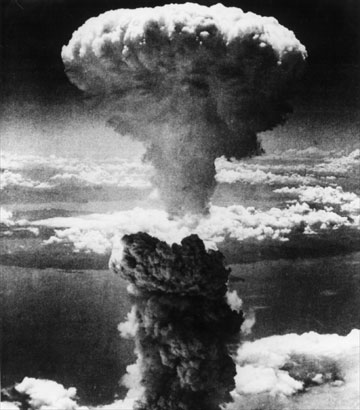
'Now there is nothing so smooth as a woman's back or so you might imagine. But if that feel is broken up for you, you would not be pleased with women's backs [...] Half of the inside of the smoothness is as rough as a bullock's hips.' [p144]This is funny stuff but it also begs the question: why would anyone want to divide pleasurable experiences up in this way? At the heart of this is a more subtle satire on the sciences (particularly physics), which, at the time O'Brien was writing, was beginning to find its logical conclusion in the great achievement of the first half of the twentieth century: The Atomic Bomb.
 Earlier in the novel, a policeman called MacCruiskeen uses a complicated device built around a mangle to implement a process he calls 'stretching the light' [p112]. This involves stressing light to a point where its wavelength changes and it becomes sound — or anything else you can imagine. What makes this scene simultaneously funny and unnerving is that MacCruiskeen and most of the other characters the narrator encounters are completely without personality. They don't seem to care about death and they tinker with these devices to no apparent end.
They are, however, all too happy to explain everything to the narrator, including something called Atomic Theory. What resemblance it bears to any real 'atomic theory' is unclear. The idea is that objects impacting one another exchange atoms and as a consequence essential properties — in the most obvious example in the book, this happens with bicycles, which seem to inherit the personalities of their riders the more time they spend on bumpy roads. Their riders meanwhile, after enough time on the saddle, find themselves unable to stay upright unless they're on the move.
Again, while this is funny, there is perhaps a serious question being asked — in using machines, do we ourselves become more machine-like? The narrator is not all flesh himself; he has a wooden leg which saves him from a couple of predicaments. And one of his asides explains how the philosopher de Selby came to understand all journeys as hallucinations, after seeing a strip of film. Influenced by the emerging technology of cinematography (albeit through a radical misunderstanding of it), de Selby reasons that time cannot 'pass as such in the accepted sense' and in an argument reminiscent of Zeno's paradox discounts space and motion too. Technology, given time, changes who we are and the way we think.
Not that the policeman who with some amount of worry explains Atomic Theory has a problem with bicycles themselves as such. Nor it seems did O'Brien — if there's a better ode to the wonders of two wheels, a saddle, and a handlebar, I don't know it.
How can I convey the perfection of my comfort on the bicycle, the completeness of my union with her, the sweet responses she gave me at every particle of her frame? [...] She moved beneath me with agile sympathy in a swift, airy stride, finding smooth ways among the stony tracks, swaying and bending skilfully to match my changing attitudes, even accommodating her left pedal patiently to the awkward working of my wooden leg. [p179]About halfway through the book, the Sargeant, MacCruiskeen and the narrator visit a subterranean bunker with seemingly endless steel corridors. The whole construct seems to defy spatial logic — leave one room by a corridor and you'll find yourself entering the same room you left albeit from a different side. While the policemen demonstrate they can produce anything they want in their bunker, making it something of a material paradise, there is a catch — the narrator can't leave with anything he asks for. This is a kind of technological hell, not so much removed from the book's strange laws of physics as possible because of them. This, finally, feels like an allegory for our times, or times that might soon be upon us — times in which we can conceivably have whatever we want, thanks to scientific progress, so long as we are willing to live in increasingly and scientifically controlled surroundings.
I'm reminded slightly of Nietzsche here: 'The press, the machine, the railway, the telegraph are premises whose thousand-year conclusion no one has yet dared to draw.' [2] Ultimately, the same solipsism that Wallace explored so well in his works also lies at the heart of The Third Policeman, which is nonetheless as amusing and entertaining as it is thought-provoking.
___________________
[1] The Charlie Rose Show — Jennifer Harbury & Robert Torricelli / David Foster Wallace (27-March-1997) Available online: http://www.charlierose.com/view/interview/5639 [Accessed 12-December-2009]. Transcript available online: http://www.badgerinternet.com/~bobkat/rose.html [Accessed 12-December-2009]
[2] The Wanderer and His Shadow. Friedrich Nietzsche. (1880) aph. 278. Available online: http://www.davemckay.co.uk/philosophy/nietzsche/nietzsche.php?name=nietzsche.1878.humanalltoohuman.zimmern.12 [Accessed 12-December-2009]


 Posts
Posts


Excellent review. This is hands down one of my favorite books. It warms my heart to see other people reading this. I was worried Flann was largely forgotten.
ReplyDeleteCheers
Thanks! I intend to seek out more of his work in the New Year, perhaps starting with At-Swim-Two-Birds...
ReplyDeleteI'm breathless! Read this book in high school after nicking it from my mother's box of grad school curios, and years later, have finally found someone else who's not only read the damn thing, but is capable of articulating a thoughtful response to what is undoubtedly a strange-ass book.
ReplyDeleteExcellent review.